
WSDOT Highlights AIWaysion’s Edge AI Graffiti Tagger Detection Technology at the Western States Forum
Updated: Oct 1
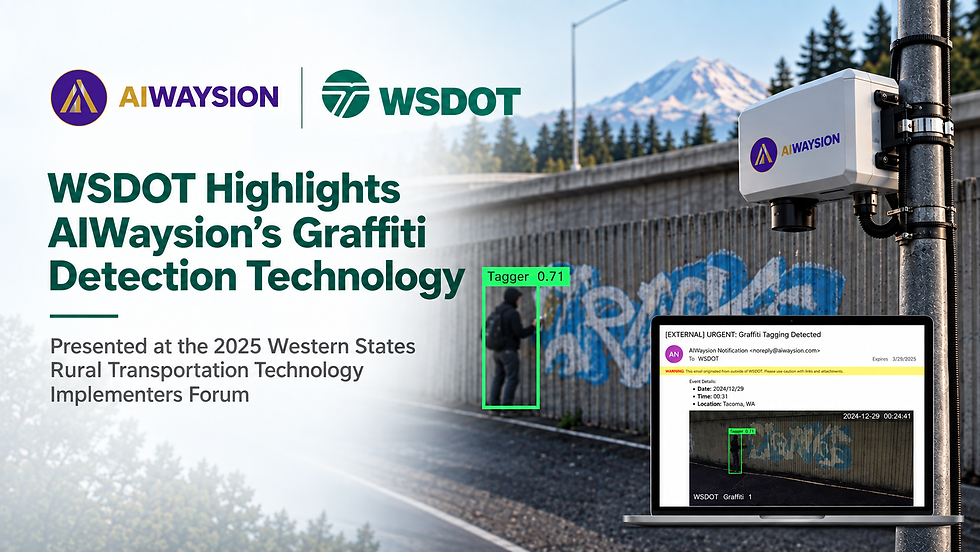
The Washington State Department of Transportation (WSDOT) highlighted AIWaysion’s Mobile Unit for Sensing Traffic (MUST) as part of its graffiti tagging detection and warning technology evaluation, presented at the 2025 Western States Rural Transportation Technology Implementers Forum. Among four vendors explored by WSDOT, the presentation identified AIWaysion’s solution as the one that was “very successful,” reporting five detected graffiti-tagging events and one arrest during the evaluation period from October 2024 through March 2025.
AIWaysion’s MUST platform combines a high-definition camera with Edge AI, machine learning, and computer vision to distinguish pedestrians from suspected graffiti taggers and generate real-time alerts. The system analyzes video directly at the edge for behaviors and activity associated with graffiti tagging, while alerts can include the event location, time, type, and relevant images or video. A web-based dashboard also enables device management, live monitoring, and alert review.
Designed as a plug-and-play roadside sensing system, MUST supports cellular connectivity and can communicate with traffic management centers and law enforcement through email, text, a web dashboard, or API integrations. WSDOT's presentation also highlighted additional capabilities of the platform, including environmental sensing, optional solar power, real-time video processing, and applications extending beyond graffiti detection to traffic and pedestrian data collection, roadway safety, connected and autonomous vehicles, and parking and curb management.
The WSDOT evaluation demonstrates how Edge AI-powered infrastructure monitoring can help transportation agencies move from passive observation toward real-time detection and response. By bringing computer vision and AI analytics directly to roadside infrastructure, AIWaysion's MUST platform offers agencies a flexible approach to monitoring transportation assets and identifying safety and operational events as they happen.

Following the successful pilot, WSDOT moved beyond a limited technology evaluation and expanded deployment of AIWaysion’s Edge AI roadside sensors along I-5 in 2025. The expanded deployment includes multiple roadside locations and solar-powered installations, allowing the system to operate in areas where conventional power and communications infrastructure may be limited.
The WSDOT deployment also demonstrates a broader model for AI-powered transportation infrastructure protection. The same sensing, Edge AI, communications, and alerting architecture can support additional applications without requiring an entirely separate roadside technology platform. AIWaysion is extending this approach to applications such as wire-theft detection and infrastructure intrusion monitoring, while MUST can also support traffic and pedestrian analytics, roadway safety monitoring, environmental sensing, connected and automated vehicle applications, and parking and curb management. Work on extending the WSDOT application toward wire-theft detection has also been underway.
Explore WSDOT’s full presentation at the 2025 Western States Rural Transportation Technology Implementers Forum here.

Comments