




Edge AI Video Analytics for Real-Time Intersection Monitoring & Safety Intervention
USDOT FY22 SBIR Phase II; City of Bellevue, WA; City of Tucson, AZ
Process video streams from city’s existing intersection cameras at the edge, detect, classify, and track various road users, identify safety-critical events in real time, and communicate low-latency interventions to the TMC and traffic signal controllers
Dynamic dilemma zone protection using upstream detection to adjust signal timing
Trajectory conflict-informed adaptive signal control, such as:
o Dynamic left-turn phasing operations.
o Dynamic "No Turn on Red" sign activation.
o Passive pedestrian detection for automatic walk time extension.
o Dynamic extension of pedestrian clearance intervals.
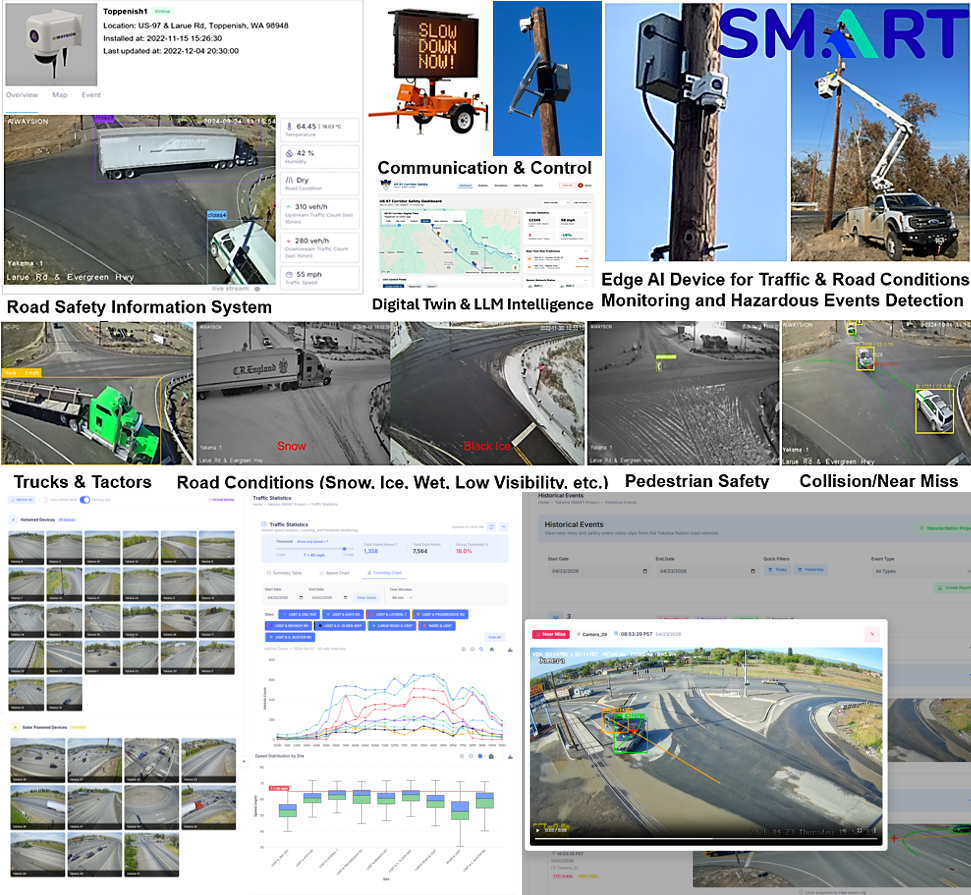
Improving Roadway and Intersection Safety Using Cost-Effective Sensing and Communication Technologies
USDOT FY23 SMART, Yakama Nation Department of Natural Resources Engineering (DNR Engineering) Program
Safety data collection (traffic, roadway surface conditions, visibility, environmental conditions, etc.)
Real-time warning of dangerous events (speeding, collision/near-miss, stopped vehicle, snow and icy road surface, low visibility/heavy fog, etc.)
Edge AI Vision and V2X for VRU Safety
DC Highway Safety Office, District of Columbia Department of Transportation, DC Southwest Business Improvement District, and the Intelligent Transportation Society of America
Roadside edge AI vision systems on M Street in Washington, DC
Monitors vehicles, pedestrians, bicyclists, and other road users; analyzes their movements and trajectories; and identifies vehicle–pedestrian conflicts, near misses, speeding, and red-light violations
Generation and transmission of messages to V2X platform, including SAE J2735 BSMs and PSMs, as well as SAE J3224 SDSMs
AI-Powered Approach to Generate and Analyze Transportation Planning & Design Data at Scale
U.S. DOT Artificial Intelligence for Transportation Planning and Design (AI TPD) Initiative
TPD Copilot
Scalable AI/CV Data Generation: Automate extraction and fusion of TPD data, covering infrastructure, traffic and safety, and contextual information, from diverse multimodal sources (e.g., satellite imagery, street-level imagery, traffic camera feeds, and IoT sensors) and convert them into standardized, GIS-compatible datasets.
Transportation-Standards-Informed LLMs, VLMs, and AI Agents: that can respond to practitioner prompts, generate contextualized scenario insights, and recommend data-driven infrastructure improvements.
SMART PARKING & CURB MANAGEMENT
New York City Department of Transportation, NY; Bellevue, WA
Edge AI CurbVision system for curb space monitoring
Events (i.e., Event Type, Vehicle Type, Location, Duration, Ingress/Egress Time); Parking Availability & Occupancy
Illegal parking, delivery, micromobility, emergency use, transit, etc.
Traffic conflicts (collision and near-miss events, etc.)
